
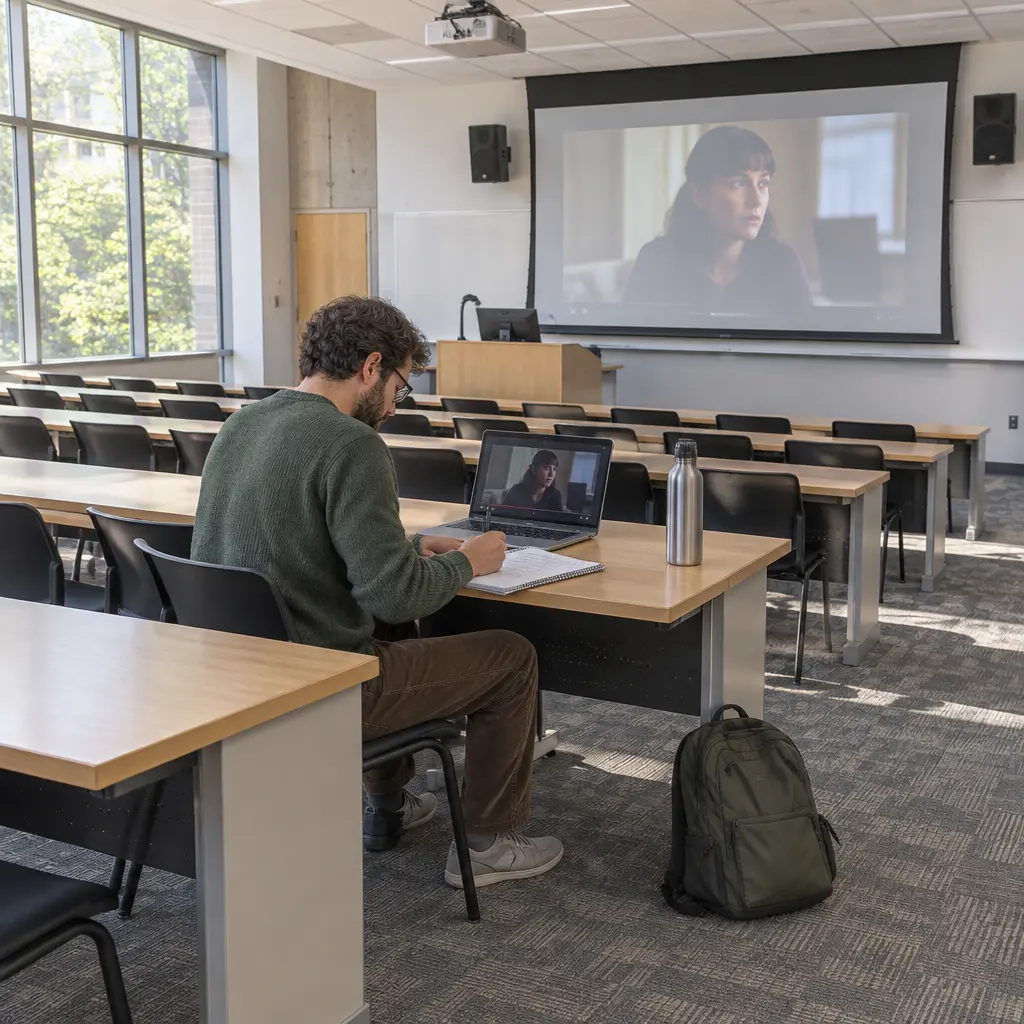
Film is a sequence of images and sounds arranged to communicate stories, ideas, and experiences. Studying film—its visual composition, editing, sound, performance, and cultural context—can make us more thoughtful viewers by training us to interpret evidence, consider multiple perspectives, and question how meaning is constructed. Research on visual storytelling and media literacy supports the value of close attention, while film scholarship offers practical ways to examine how choices such as a camera angle or a cut shape our understanding. These benefits are not automatic: they grow through active viewing, discussion, and comparison. The sections below explain how film study develops visual analysis, critical reasoning, perspective-taking, and media literacy, with examples and research context.
Film Study Strengthens Visual and Narrative Reasoning
Film study is the systematic analysis of how moving images and sound create meaning. Film scholar David Bordwell and film historian Kristin Thompson describe film analysis as attention to the relationships among a movie’s form, style, and overall effect. Instead of treating a scene as a transparent record of events, viewers examine how framing, lighting, movement, editing, performance, and sound guide interpretation.
This approach develops a habit of asking not only what happens, but how a film makes it seem important, believable, or emotionally compelling. Its key practices include close viewing, evidence-based interpretation, and comparison across scenes or works. Together, these practices connect visual analysis with broader forms of critical thinking.
Visual literacy: Reading images as constructed evidence
Visual literacy is the ability to interpret and evaluate information presented through images. Film gives viewers a rich setting to practise it because every image is selective: the frame includes some details and excludes others. A close-up may direct attention to a character’s reaction, while a wide shot can make that character appear isolated within a larger space.
A useful viewing exercise is to pause after a striking shot and identify its observable features before proposing an interpretation. A viewer might note that a character is placed at the edge of the frame, then ask whether that composition suggests exclusion, uncertainty, or simply a practical staging choice. Separating observation from inference makes an argument easier to test and revise.
Narrative reasoning: Inferring causes, motives, and consequences
Narrative reasoning is the process of understanding how events, motives, and consequences fit together. Films encourage viewers to form hypotheses, hold questions in mind, and adjust their interpretations when new evidence appears. A character’s silence, a repeated image, or an unexplained cut may gain significance later, prompting viewers to reconsider what they previously believed.
This process resembles everyday reasoning: people make provisional judgments with incomplete information and update them as circumstances change. Studying a film can make that process visible. Viewers can compare an early prediction with the eventual outcome and identify which details supported—or undermined—their assumptions.
Film Study Develops Critical Thinking Through Form
Critical thinking involves evaluating claims, examining evidence, and considering alternative explanations. Film study provides concrete material for these tasks because cinematic meaning is shaped by choices rather than delivered neutrally. A film’s form—how its images and sounds are organized—can influence what viewers notice, feel, and conclude.
The American Film Institute’s film-education resources, for example, encourage students to examine how elements of film language contribute to meaning. The same principle can be applied to any movie: identify a formal choice, point to evidence in the scene, and explain why that evidence supports an interpretation. This method helps distinguish reasoned analysis from unsupported opinion.
Editing: Testing how sequence shapes meaning
Editing is the selection and arrangement of shots. A cut can connect two events, create a contrast, accelerate time, or invite viewers to infer a relationship. Soviet filmmaker Sergei Eisenstein’s writing on montage made the relationship between adjacent images a central topic in film theory: the meaning viewers perceive may arise from the combination, not just from either shot alone.
To see this in practice, compare a scene’s original sequence with a thought experiment in which the shots are reordered. If a reaction shot follows one character’s remark, viewers may read the reaction as a response; place it elsewhere, and that link can weaken or change. Such analysis trains viewers to ask whether an apparent cause-and-effect connection is established by the story or suggested by the edit.
Sound and cinematography: Auditing emotional cues
Cinematography is the creation of moving images through choices such as camera placement, lens, lighting, and movement. Film sound includes dialogue, music, ambience, and effects. These elements can reinforce one another, but they can also create tension: an image may appear calm while the soundtrack signals danger.
A practical exercise is to watch a scene once with sound and once without it, then compare the interpretations. The contrast can reveal how music or sound effects steer emotion and expectation. This does not mean emotional responses are false; it means viewers can notice the cues influencing them and consider whether the scene offers other plausible readings.
Film Study Encourages Perspective-Taking and Cultural Analysis
Perspective-taking is the effort to understand how situations may appear from someone else’s position. Films can support this practice by placing viewers close to characters whose circumstances, beliefs, or social experiences differ from their own. However, a film presents a designed perspective, not unfiltered access to another person’s life. Critical viewing therefore combines empathy with questions about representation and point of view.
Research on narrative engagement offers relevant, though carefully bounded, evidence. In a 2013 study published in Science, psychologists Emanuele Castano and David Comer Kidd reported that reading literary fiction improved performance on some measures of social cognition compared with reading nonfiction, popular fiction, or nothing. The study concerned reading rather than film and does not prove that watching movies produces the same effect. It nevertheless provides a reason to investigate how engagement with complex narratives may invite attention to other minds.
Point of view: Distinguishing whose experience is shown
Point of view is the position from which a story or scene presents information. A film may align viewers with one character by limiting what they know to that character’s knowledge, or it may show events that the character cannot see. Recognizing these differences helps viewers identify whose concerns receive attention and whose remain outside the frame.
For example, a scene may show a conflict through one person’s reactions while leaving the other person’s motives unexplained. Viewers can ask what evidence the film provides about each character, what remains uncertain, and how the perspective might change if the scene were told from another position. That exercise encourages curiosity without assuming that all interpretations are equally supported.
Representation: Examining patterns and omissions
Representation concerns how people, communities, and social experiences are depicted. Film analysis can examine who gets to speak, who drives the action, how characters are framed, and whether a group is shown with variety or reduced to a familiar stereotype. It can also consider production context, including who created the work and which audiences it addresses.
The Geena Davis Institute on Gender in Media uses research and industry analysis to examine representation in entertainment. Its work illustrates how questions about screen presence and character roles can be investigated systematically rather than left at the level of impression. When studying any film, viewers can similarly record who appears, whose choices affect the plot, and whose perspective receives sustained attention, while avoiding broad conclusions from a single example.
Film Study Builds Media Literacy for Everyday Viewing
Media literacy is the ability to access, analyze, evaluate, create, and act using media. The U.S. National Association for Media Literacy Education describes these as connected competencies. Film study applies them to a familiar medium and can help viewers assess how stories are shaped, how evidence is presented, and how emotional appeal works.
The need is not limited to feature films. Short videos, advertisements, trailers, and online clips also rely on framing, editing, music, and selective context. UNESCO’s media and information literacy work likewise emphasizes the importance of evaluating media messages and their sources. Film analysis offers a practical vocabulary for doing so, although it should complement—not replace—fact-checking and source verification.
Evidence and persuasion: Separating what is shown from what is claimed
A film can persuade through both explicit statements and presentation. A documentary, for instance, may combine interviews, archival images, narration, and music to advance an argument. A careful viewer asks where a claim comes from, whether the footage supports it, what context may be missing, and whether another source confirms the facts.
The same questions apply to fictional works, though the standard of factual verification differs. Viewers can distinguish between what a story depicts and what it asks them to believe about society. This distinction is especially useful when a film draws on historical events or presents itself as realistic.
Active viewing: A repeatable method for better interpretation
Active viewing means watching with deliberate questions rather than treating the film as background. A simple method is to note a scene’s key choice, gather visible or audible evidence, propose an interpretation, and consider an alternative explanation. Rewatching a short sequence can help test whether the interpretation fits the details.
For a group discussion, each participant can identify one observation and one question before offering a conclusion. This keeps conversation grounded in the work and makes disagreement productive: people can compare evidence rather than merely defend preferences. A chart can help organize the process, with columns for “film choice,” “evidence,” “possible effect,” and “alternative reading.”
Conclusion: Film Study Makes Thought More Deliberate
Studying film can strengthen visual literacy, narrative reasoning, critical evaluation, perspective-taking, and media literacy. Close analysis shows how editing, sound, cinematography, and point of view shape meaning; attention to representation invites questions about whose experiences are visible; and active viewing helps people distinguish evidence from inference. Research on narrative engagement offers related context, but film study should be understood as a practice that develops through discussion and reflection, not as a guaranteed cognitive effect.
To begin, choose a short scene, watch it twice, and write down what the film shows before deciding what it means. Then compare interpretations with someone else and identify the evidence behind each one. This small habit can turn everyday viewing into a useful exercise in careful, open-minded thinking.
Sources: Bordwell, David, and Kristin Thompson, Film Art: An Introduction, McGraw Hill, https://www.mheducation.com/highered/product/film-art-introduction-bordwell-thompson/M9781260565669.html; American Film Institute, AFI Education, https://www.afi.com/education/; Eisenstein, Sergei, Film Form: Essays in Film Theory, Harcourt, Brace and Company, https://archive.org/details/filmformessaysin00eise; Castano, Emanuele, and David Comer Kidd, “Reading Literary Fiction Improves Theory of Mind,” Science, 2013, https://www.science.org/doi/10.1126/science.1239918; Geena Davis Institute on Gender in Media, Research, https://geenadavisinstitute.org/research/; National Association for Media Literacy Education, Core Principles of Media Literacy Education, https://namle.org/resources/core-principles/; UNESCO, Media and Information Literacy, https://www.unesco.org/en/media-information-literacy.