
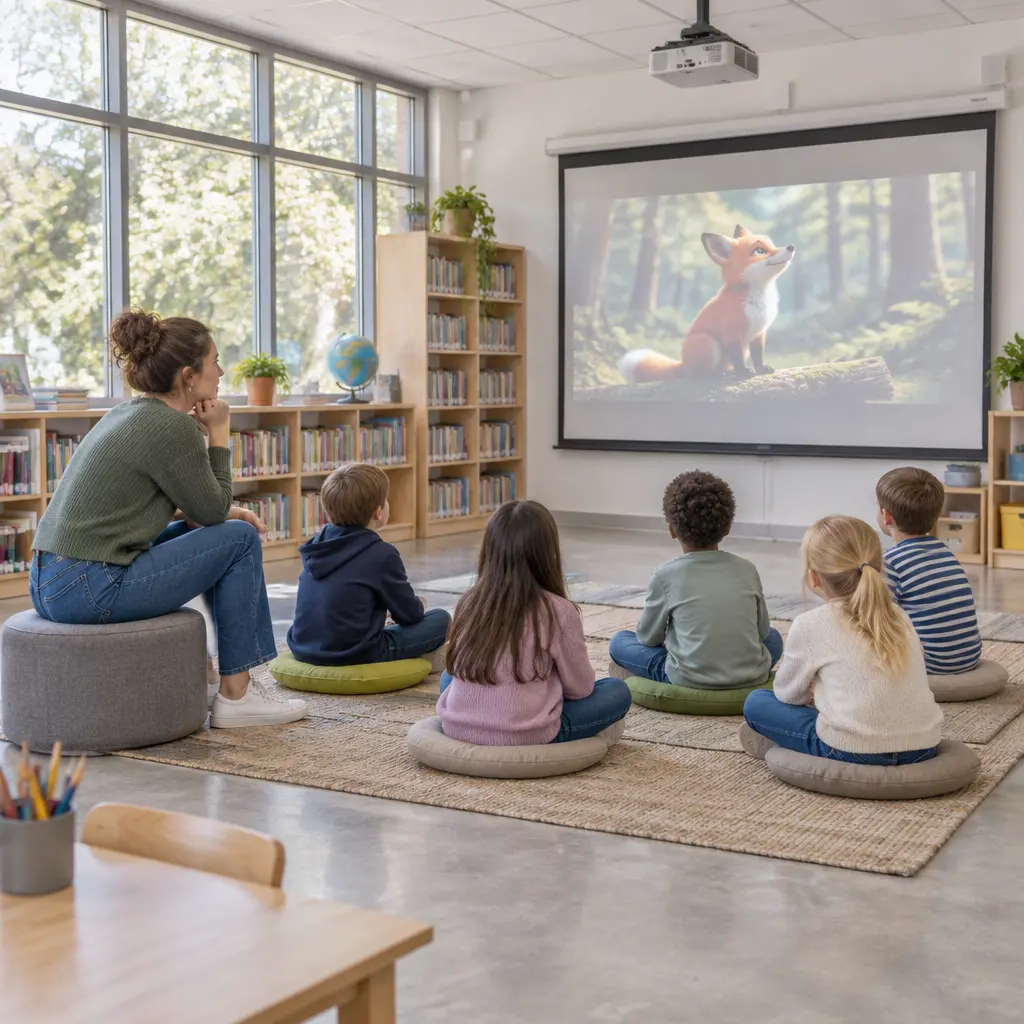
Children often understand cinema instinctively because they are skilled at reading faces, movement, sound, repetition, and emotional cause and effect—even before they can explain how a film works. Cinema is a moving audiovisual story, and young viewers can follow its cues without knowing terms such as “editing” or “point of view.” Developmental research helps explain this ability: infants show sensitivity to faces and biological motion, while studies of children’s attention find that comprehension develops alongside age and experience. This article explores how children read film language, why emotion and sound help them follow stories, what developmental limits remain, and how educators and families can support thoughtful viewing.
Children’s cinematic understanding: a developmental account
Children’s cinematic understanding is the ability to interpret a film’s images, sounds, actions, and transitions as a meaningful sequence. It is not a single skill or a claim that every child understands every film: it draws on attention, perception, memory, language, social understanding, and prior experience. Researchers Karen E. Schwan and Peter C. R. Garsoffky describe film comprehension as a process in which viewers integrate information across shots and construct a coherent account of events.
The word “instinctively” is useful as a shorthand, but it needs qualification. Children are prepared to notice socially and biologically meaningful signals, such as faces, voices, and goal-directed movement. Their ability to interpret conventions—including flashbacks, rapid cutting, or an unreliable narrator—still grows with age and exposure. The National Institute of Child Health and Human Development reports that newborns can imitate some facial gestures, while developmental research on biological motion finds that even young infants attend to movement patterns associated with living beings. These predispositions give cinema a legible starting point, not a complete, inborn film literacy.
Children’s visual perception and film cues
Visual perception is the process of selecting and interpreting information from what the eyes see. In film, children use it to identify characters, track movement, notice changes in setting, and infer which details matter. This capacity connects ordinary scene perception to cinematic devices such as framing, close-ups, and cuts: a shot can direct attention, while a change of shot asks the viewer to connect two views of the same unfolding event.
Faces, gaze, and emotion
Faces are especially informative because they communicate emotion, attention, and social intention. A close-up of a worried character may help a child infer that something has gone wrong even when the dialogue is sparse. Research reviewed by developmental psychologists Vanessa Lobue and Judy S. DeLoache shows that infants attend to faces early in life, although recognizing what an expression means and using it to interpret a complicated scene develop over time.
Gaze also functions as a visual cue: when a character looks off-screen, viewers often anticipate that the next shot will reveal what the character sees. This is a learned convention supported by a broader sensitivity to where other people are looking. It offers a simple example of cinema’s alignment with everyday social perception.
Movement, action, and visual continuity
Biological motion is movement that appears to come from a living body, such as walking or reaching. Studies using point-light displays—small lights attached to a moving person—show that observers can recognize human action from remarkably sparse visual information. Children’s sensitivity to movement helps them follow a character’s goal, distinguish an intentional action from a mishap, and understand why one event follows another.
Film editing relies on viewers treating separate shots as parts of a continuous scene. Children can often follow straightforward cuts, especially when the action and setting remain clear, but continuity is not automatic in every case. A sudden change of location, an abrupt time jump, or a rapid montage may require more working memory and contextual knowledge. The distinction matters: recognizing a character’s action is not identical to understanding the editor’s arrangement of that action.
Children’s narrative comprehension and film editing
Narrative comprehension is the ability to connect events into a story involving characters, goals, obstacles, and outcomes. In cinema, viewers must often infer links that are not explicitly stated. They may see a character reach for a key, hear a sound, and then watch a door open; understanding the scene means combining those cues into a causal sequence. This is one reason films can be accessible to children before they have the vocabulary to describe their interpretation.
Causal reasoning and character goals
Causal reasoning means working out how one event produces or motivates another. Developmental studies of children’s story understanding show that young viewers and readers are particularly helped by clear goals and consequences. A child may grasp that a character is searching for a lost toy, then interpret later actions in light of that goal. Repeated cues—such as showing the missing toy, the character’s worried face, and the search—reinforce the connection.
This skill also supports emotional interpretation. If a character gives away a treasured object, a child may infer generosity, reluctance, or sadness from the action and surrounding context. Such inferences vary with the child’s experience and the story’s clarity; they should not be mistaken for proof that children automatically understand every motive or moral ambiguity.
Cuts, time shifts, and point of view
Editing is the selection and ordering of shots. A cut can move attention, compress time, change location, or reveal information. A simple cut from a character looking upward to a bird in the sky is usually easy to interpret because the two shots form a clear gaze pattern. A flashback or parallel storyline is more demanding because the viewer must keep track of when and where events occur.
Film-comprehension research by Schwan and Garsoffky emphasizes that viewers use both perceptual continuity and knowledge of narrative conventions to connect shots. Children may understand a sequence’s basic action while missing a subtle shift in chronology or perspective. For teachers and caregivers, asking “What changed?” or “Whose view are we seeing?” can reveal the difference between following events and interpreting film form.
Children’s audiovisual attention and emotional engagement
Audiovisual attention is the coordination of information from sight and sound. Film makes extensive use of this coordination: dialogue identifies speakers, music signals mood, and sound effects can direct attention toward an event outside the frame. Children’s engagement can therefore reflect not only what they see, but also how sound guides their expectations and emotions.
Music, voice, and sound effects
Music and sound effects provide cues about tension, surprise, and emotional tone. A rising musical phrase may prepare viewers for a revelation; a sudden silence may make a small movement feel significant. Infants are responsive to voices and sound patterns, but interpreting a musical cue as ironic, frightening, or reassuring depends on context and experience.
Audio can also clarify visual action. A character calling from another room may explain why someone turns toward a doorway, while an off-screen crash can prompt viewers to imagine an unseen event. This is an example of sound expanding the story world beyond the image, a technique that can both aid comprehension and create suspense.
Emotion, identification, and imaginative play
Emotional engagement is the process of responding to characters and events with feelings such as concern, delight, or fear. Children may identify with a protagonist by imagining the character’s goals and reactions. Such engagement can make story events memorable, but it does not mean that a child confuses fiction with reality in every situation or interprets a scene exactly as an adult would.
Pretend play offers a useful parallel. In play, children can treat an object as something else while still operating within an imagined scenario. Similarly, they can respond emotionally to a fictional character while gradually learning how film constructs that character’s world. Co-viewing and conversation help children distinguish what happened in the story from what is real and discuss how a scene made them feel.
Children’s film literacy and its developmental limits
Film literacy is the ability to understand and critically interpret moving images and sound. It includes basic story comprehension as well as awareness of how framing, editing, performance, music, and genre shape meaning. Children can show strong intuitive responses while still needing support with conventions that are indirect, culturally specific, or deliberately ambiguous.
Age, attention, memory, and prior knowledge
Working memory helps viewers retain information while connecting one shot to another; attention helps them notice the information in the first place. Both develop through childhood, so a long sequence with many characters and rapid changes can be harder to follow than a short, clearly structured scene. Familiar stories and repeated viewing can reduce the burden by letting children anticipate what comes next.
There is no single age at which every child understands film in the same way. Language development, sensory needs, cultural context, previous viewing, and individual differences all matter. The American Academy of Pediatrics advises families to consider the quality and context of children’s media, not just screen time totals. Its policy statement also recommends avoiding digital media, other than video-chatting, for children younger than 18 months and choosing high-quality programming with an adult for children aged 18 to 24 months.
From intuitive viewing to critical interpretation
Critical interpretation means asking how a film produces its effects and whose perspective it presents. A child may readily say that a scene feels scary, then gradually learn to identify the low lighting, music, camera angle, or delayed reveal that created that feeling. This progression turns an immediate response into an understanding of film technique.
A practical way to support that progression is to pause after a short sequence and invite observation rather than test for a single “correct” answer. Ask what the child noticed, what a character wanted, or how the sound changed the scene. These open questions encourage attention to evidence and make room for different interpretations.
Children’s cinema learning in classrooms and at home
Cinema can support learning when adults treat viewing as an opportunity for shared attention and discussion, rather than as a passive activity or a quiz. The British Film Institute’s education resources, for example, encourage close viewing and discussion of how film form creates meaning. Short clips are often particularly useful because children can revisit a visual or sound cue without having to retain an entire feature-length plot.
A short-scene case study
Consider an animated scene in which a character hears a noise, looks toward a dark doorway, and steps closer while the music grows quieter. A child can infer a likely chain of events: the sound attracts attention, the character investigates, and the silence signals uncertainty. An adult can then connect the inference to filmmaking choices by asking why the director showed the character’s face before revealing what was behind the door.
This example illustrates several connected skills: reading facial expression, tracking an action, linking cause and effect, interpreting sound, and noticing the order of shots. It also shows why a child’s initial response may be accurate even when the child cannot yet name the techniques. A simple storyboard—three boxes for the sound, the reaction, and the reveal—can make those relationships visible.
A practical viewing routine
Families and educators can support film understanding with a brief routine before, during, and after viewing:
- Before viewing, introduce the setting or a few unfamiliar words without explaining every plot point.
- During viewing, notice moments when a child reacts strongly; pause only when it will not disrupt the story’s emotional flow.
- After viewing, ask what the character wanted, which clue mattered, and how music or camera choices shaped the scene.
- Invite children to draw, retell, or act out a sequence, which can reveal how they connected its events.
Conclusion: children’s cinematic understanding and media literacy
Children often seem to understand cinema instinctively because film speaks through cues they are already developing: faces, movement, voices, emotional reactions, and visible consequences. Visual perception helps them read actions and expressions; narrative comprehension helps them connect goals and outcomes; audiovisual attention adds music and sound; and developing film literacy lets them recognize how editing and point of view shape what they see.
That instinct is a foundation, not a guarantee of complete understanding. Attention, memory, language, experience, age, and the complexity of a film all affect interpretation. Adults can nurture children’s abilities by choosing age-appropriate material, watching together, and asking open questions about both story and technique. For further learning, explore the British Film Institute’s film-education materials and the American Academy of Pediatrics’ guidance on children’s media use.
Sources: Schwan, Karen E., and Peter C. R. Garsoffky, “The Cognitive Representation of Film,” in The Psychology of Media and Communication, 2008, https://doi.org/10.1016/B978-0-12-369425-6.00004-7; National Institute of Child Health and Human Development, “Newborn Imitation: Fact or Fiction?” https://www.nichd.nih.gov/newsroom/releases/110614-newborn-imitation; American Academy of Pediatrics, “Media and Young Minds,” Pediatrics, 2016, https://doi.org/10.1542/peds.2016-2591; American Academy of Pediatrics, “Media Use in School-Aged Children and Adolescents,” Pediatrics, 2016, https://doi.org/10.1542/peds.2016-2592; Lobue, Vanessa, and Judy S. DeLoache, “Detecting the Snake in the Grass: Attention to Fear-Relevant Stimuli by Adults and Young Children,” Psychological Science, 2008, https://doi.org/10.1111/j.1467-9280.2008.02118.x; British Film Institute, “BFI Education,” https://www.bfi.org.uk/education-research/education.