
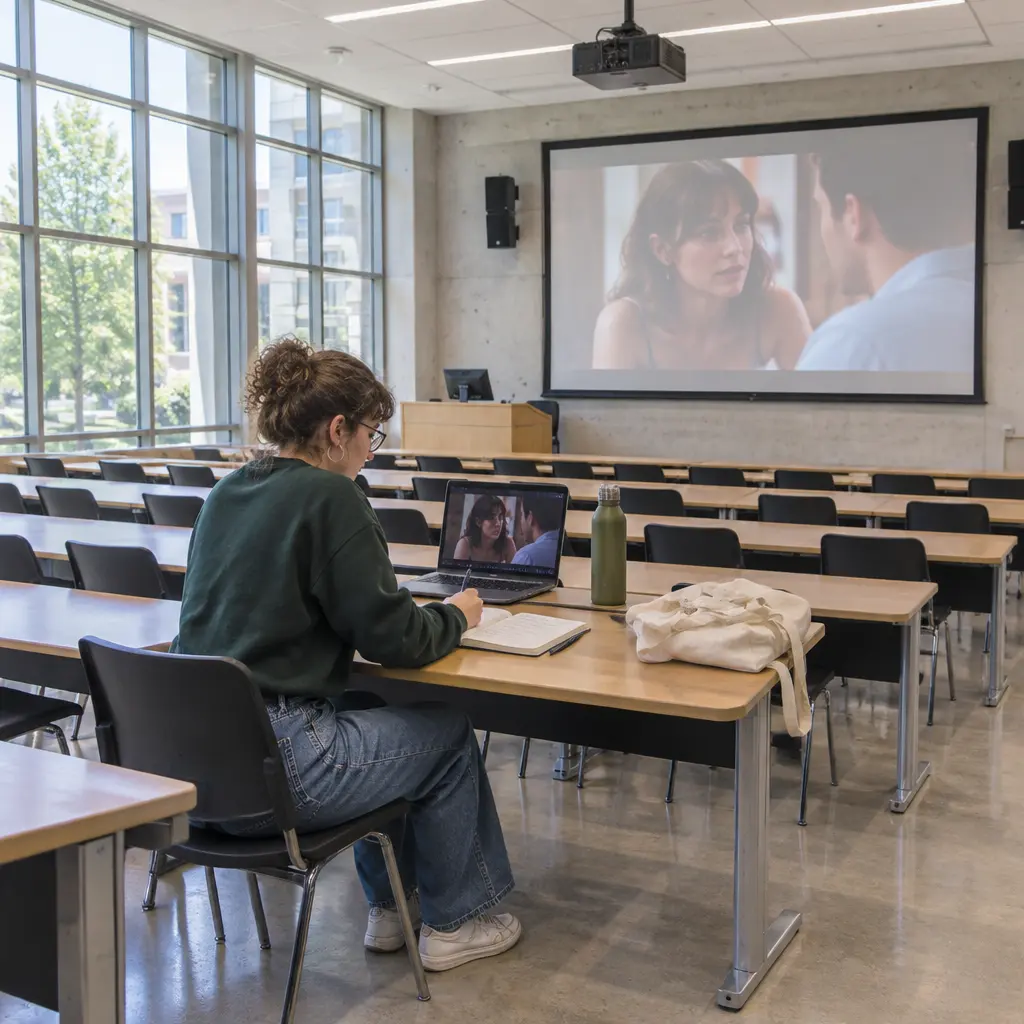
Watching a film like a filmmaker means looking beyond what happens in the story to notice how images, sound, performance, editing, and production design shape what an audience feels and understands. Film scholar David Bordwell describes film style as the systematic use of cinematic techniques; in practice, that means observing choices, asking what they do, and checking how they work together. This approach is useful for viewers, students, and aspiring filmmakers: it turns passive viewing into a repeatable method of analysis without requiring specialist equipment. The sections below explain how to examine framing and camera movement, lighting and color, performance and mise-en-scène, editing and sound, and how to apply those observations to a real film.
Film Analysis Begins with Attention to Form
To watch like a filmmaker is to treat a film as both a story and a constructed audiovisual experience. Rather than asking only “What happened?”, ask “How did the film make me notice, feel, or expect that?” David Bordwell and Kristin Thompson’s widely used textbook Film Art: An Introduction organizes film study around form and style: form concerns how a film’s parts relate to one another, while style refers to the patterned use of techniques such as cinematography, editing, sound, and mise-en-scène.
This distinction matters because a single technique rarely carries a fixed meaning. A close-up might invite intimacy, reveal a reaction, or make a character seem trapped; its effect depends on timing, performance, lighting, sound, and what preceded it. A filmmaker-minded viewer therefore gathers evidence before drawing conclusions. The goal is not to guess what a director intended, but to describe what is on screen and explain how specific choices contribute to the experience.
Separate observation from interpretation
Observation records what can be directly seen or heard: the camera remains still, a character is framed at the edge of the image, or traffic noise continues under dialogue. Interpretation proposes an effect: the stillness may make the room feel tense, or the character’s position may suggest isolation. Keeping these steps separate makes analysis more precise and helps avoid treating a personal reaction as an indisputable fact.
Track patterns, not isolated tricks
A technique becomes especially meaningful when it recurs or changes. If a film repeatedly places one character in deep focus while another is blurred, that visual contrast may organize attention or express a shifting relationship. Note the pattern, identify moments that break it, and ask what changes in the story at those points. This is more reliable than assigning a symbolic meaning to one striking shot.
Cinematography Shapes What the Viewer Sees
Cinematography is the arrangement and recording of moving images, including framing, camera position, lens choice, movement, focus, and exposure. In Film Art, Bordwell and Thompson treat cinematography as one of the principal systems through which a film’s style becomes visible. When watching, consider not just what is inside the frame, but why the frame includes it and how the image changes over time.
Framing, camera angle, and composition
Framing determines the boundaries of the image and the relative size of people and objects within it. A wide shot can establish geography or make a person appear small in an environment; a close-up can prioritize a facial response or a significant object. High and low camera angles may affect how a subject is perceived, but their impact depends on context rather than a universal visual code.
Look for visual relationships: who occupies the center, who is partly obscured, what lines lead the eye, and whether foreground objects divide the space. In Steven Spielberg’s Jaws (1975), the famous beach scene uses a long lens and a gradual push-in on Chief Brody while the background remains active. The movement draws attention to his reaction without stopping the crowded beach from feeling ordinary—a useful example of camera technique supporting both character and suspense.
Camera movement, lens, and focus
Camera movement can follow a character, reveal new information, or make the viewer feel unstable. A pan rotates from a fixed position; a tilt moves vertically; a tracking or dolly shot changes the camera’s position through space. Ask whether movement follows an action, anticipates it, or seems to observe from a distance. Also notice whether focus shifts between foreground and background, redirecting attention within a shot.
Lens and focus choices alter spatial appearance. A wide-angle lens can exaggerate near-far distances, while a long lens can make distant planes appear compressed. Deep focus keeps several distances relatively sharp; shallow focus isolates a narrower plane. Rather than memorizing effects as rules, compare shots in the same film and note how changes in perspective guide attention or alter the scene’s emotional texture.
Mise-en-Scène and Performance Build the Screen World
Mise-en-scène refers to what is arranged before the camera: setting, props, costume, makeup, lighting, and the placement and movement of performers. Bordwell and Thompson use the term to describe the staging of the shot. Studying mise-en-scène reveals how a film communicates through its constructed world, including details that dialogue may never explain.
Setting, props, costume, and color
A setting establishes more than location. Its scale, condition, and layout can define what characters can do and how they relate to one another. Props may become practical tools, clues, recurring motifs, or sources of conflict. Costume can distinguish social roles or show change over time. Track a detail when it appears, disappears, or changes hands; its importance is often established through repetition and context.
Color is similarly contextual. A film may use a restricted palette, contrast warm and cool tones, or reserve a vivid color for a particular object. Record where and when a color appears before assigning it meaning. In The Grand Budapest Hotel (2014), director Wes Anderson and cinematographer Robert Yeoman use carefully coordinated production design, costume, and color to make different periods and locations feel distinct. The palette is not merely decorative: it helps organize the film’s shifting historical frames and highly controlled visual world.
Lighting and the shape of the image
Lighting affects visibility, contrast, texture, and mood. Notice the direction and softness of light, the shadows it creates, and whether a scene appears evenly illuminated or strongly divided between light and dark. Also ask whether the light seems motivated by a visible source, such as a window or lamp, or feels deliberately stylized. The same location can appear welcoming or threatening through changes in contrast and color temperature.
Blocking and acting choices
Blocking is the planned movement and positioning of performers in a scene. Watch who moves first, who stays still, how characters use distance, and whether an object or doorway separates them. Performance includes more than dialogue: pauses, posture, gaze, gesture, breath, and the timing of a reaction all shape characterization. Compare what a character says with what their body does, and notice whether the camera gives the reaction space to register.
Editing and Sound Control Rhythm and Attention
Editing connects shots and scenes into a temporal and spatial experience. Sound includes dialogue, music, effects, and ambience, whether those sounds originate within the story world or are added for the audience. Together, editing and sound can make a scene feel continuous, fragmented, calm, or urgent. They also determine what the viewer notices and when.
Cutting, continuity, and duration
Continuity editing aims to make screen action and space easy to follow, while other editing styles may emphasize discontinuity or surprise. Watch how a scene moves between wide shots, close-ups, and reaction shots; whether an action seems to continue smoothly across a cut; and how long each shot lasts. A cut can reveal information, hide it, create a comparison, or change the pace. A long take can preserve the duration of an event and allow viewers to inspect the frame for themselves.
Pay attention to transitions between scenes as well. A sound that begins before a new image, or continues after a cut, can link separate places or moments. An abrupt cut may create a jolt, while a gradual transition can suggest passage or memory. To understand the effect, compare the transition with the scene’s preceding rhythm rather than judging it alone.
Music, dialogue, effects, and silence
Film sound can be diegetic—part of the story world, such as a radio playing in a room—or nondiegetic, such as a score heard only by the audience. Listen for changes in volume, distance, reverberation, and overlap. A quiet background may make a small sound startling; music can reinforce an emotion, complicate it, or create irony. Silence is often a relative effect: the removal of music or ambient noise can make a pause feel unusually exposed.
Sound can also connect images that are not shown together. In Francis Ford Coppola’s The Godfather (1972), the baptism sequence crosscuts Michael Corleone’s participation in a church ceremony with acts of violence elsewhere. The contrast between ritual dialogue and violent images creates meaning through the interaction of editing and sound, rather than through either element alone.
A Repeatable Method Turns Viewing into Analysis
A practical viewing method separates the first emotional experience from closer inspection. Rewatching is not a requirement for understanding a film, but it can reveal patterns that are difficult to register while following the story. The American Film Institute’s film-education resources similarly encourage close attention to how cinematic choices communicate, making a structured viewing process useful in classrooms as well as personal study.
First viewing: follow the experience
On the first viewing, watch without pausing. Record only brief notes about strong reactions, confusing moments, repeated images, or changes in tone. Afterward, summarize what the film seems to ask the audience to feel or understand. These notes provide a baseline for comparing your initial response with evidence from the film’s craft.
Second viewing: examine a scene closely
Choose a short scene and watch it again, focusing on one system at a time. First track framing and movement; then observe blocking, lighting, and production design; finally listen for edits, music, effects, and silence. Write down concrete details and time stamps if useful. This focused approach prevents the analysis from becoming a vague list of impressions.
Build an evidence-based interpretation
Use a simple chain: technique, evidence, effect, and larger function. For example: “The scene holds on the listener after the speaker finishes; the pause lets the reaction dominate; this makes the exchange feel emotionally unresolved.” A strong interpretation can be challenged and refined because it points to visible or audible evidence. If a detail does not support the interpretation, revise the claim rather than forcing the detail to fit.
A useful viewing chart can include four columns: timestamp, what is seen or heard, the technique involved, and the possible effect. For a classroom or film club, members can compare charts and discuss where their readings differ. The disagreement often reveals that a technique supports multiple interpretations, not that one viewer has failed to notice the “correct” meaning.
Conclusion: Watch for Choices, Patterns, and Effects
Watching a film like a filmmaker means connecting its choices to the experience they create. Cinematography shapes the image; mise-en-scène and performance construct the screen world; editing and sound organize rhythm, space, and attention. A repeatable method—observe carefully, identify patterns, and support interpretations with evidence—makes film analysis clearer and more rewarding.
For your next film, choose one scene and study it twice: first for your emotional response, then for the details that produced it. Compare your notes with a friend’s, or consult a film-studies text to explore a technique further. The more precisely you notice how a film works, the more possibilities you can recognize in both viewing and filmmaking.
Sources: David Bordwell and Kristin Thompson, Film Art: An Introduction, 12th edition, McGraw Hill, https://www.mheducation.com/highered/product/film-art-introduction-bordwell-thompson/M9781260565669.html; American Film Institute, AFI Education, https://www.afi.com/education/; Encyclopaedia Britannica, “Jaws,” https://www.britannica.com/topic/Jaws-film-by-Spielberg; Encyclopaedia Britannica, “The Grand Budapest Hotel,” https://www.britannica.com/topic/The-Grand-Budapest-Hotel; Encyclopaedia Britannica, “The Godfather,” https://www.britannica.com/topic/The-Godfather-film-by-Coppola