
Film Experience and Age: How Children and Adults Watch, Feel, and Interpret Movies
Film experience is the way viewers perceive, understand, and emotionally respond to moving images and sound. Children and adults can watch the same movie yet take away different things: children are more likely to rely on visible action, concrete events, and immediate emotions, while adults can draw on broader knowledge, life experience, and more developed reasoning to interpret themes and ambiguity. These are general tendencies, not fixed rules; age, individual development, culture, and the film itself all matter. Research on children’s cognitive development and media use helps explain the contrast, while viewing guidance from the American Academy of Pediatrics underscores the importance of age-appropriate content and context.
Film Experience and Age: Defining the Difference
Film experience varies with a viewer’s developing abilities to attend, remember, understand stories, interpret images, and regulate emotion. The American Academy of Pediatrics (AAP) describes media as part of children’s broader social and developmental environment, rather than as an isolated influence. In practice, that means a movie’s effects depend not only on what appears onscreen, but also on the child’s age, temperament, previous experiences, viewing setting, and conversations with adults.
A useful distinction is between comprehension—following what happens—and interpretation—working out what it means. A young child might accurately describe a character running away but miss why the character is frightened or what an earlier scene implies. An adult may connect that scene to a hidden motive, a social issue, or a filmmaking choice. Developmental patterns are not universal: children differ from one another, and adults may also miss meanings or respond strongly to a film’s sensory elements.
Attention and sensory response
Attention is the ability to select and sustain focus on information. Film competes for attention through movement, music, color, editing, and changes in sound. Younger viewers may be especially drawn to salient action and may have more difficulty separating a central plot point from visually striking details. Adults typically bring more practiced strategies for following a story across scenes, although distraction, fatigue, and personal interest affect viewers of every age.
The AAP’s policy statement on media and young minds emphasizes that children’s developmental stage matters when considering media use. This does not mean every child reacts to fast editing or loud sound in the same way. It does mean that sensory intensity, frightening imagery, and the pace of a film are relevant when caregivers choose what to watch and how to discuss it.
Story comprehension and memory
Narrative comprehension is the ability to connect events, characters, motives, and consequences into a coherent story. Understanding a film may require remembering a detail from an earlier scene, inferring why a character acted, and distinguishing a flashback or fantasy from the present. Developmental research, including work summarized by psychologist Jean Piaget, describes how children’s reasoning changes as they grow, but contemporary developmental science also stresses that abilities vary by task and experience.
Adults often have an advantage in interpreting indirect clues because they have accumulated more knowledge about social relationships, genres, and conventions such as foreshadowing. Children may follow the main action while overlooking a subtle clue or an implied change in time. Rewatching, pausing, and asking open questions can help reveal what a child understood without turning a movie into a test.
Film Experience and Age: Emotional Responses
Emotional response refers to feelings elicited by a film, such as joy, fear, sadness, or suspense. Children and adults can feel the same emotion but differ in how they interpret its source, anticipate what comes next, and recover afterward. Because younger children may have less experience distinguishing fictional danger from real-world risk, a frightening scene can feel immediate even when an adult sees its conventions as harmless storytelling.
The distinction is not simply that children feel more and adults feel less. Adults can experience intense reactions too, while children may be highly resilient when a story feels safe and understandable. Content, temperament, prior experiences, and the presence of a trusted adult all shape the response.
Fear, suspense, and perceived threat
Fear in film arises when viewers perceive a threat, while suspense involves anticipating an uncertain outcome. A child may be frightened by a monster, separation, or a character in danger without fully understanding that the events are fictional. Adults are more likely to recognize genre cues—such as ominous music or a familiar horror setup—but recognition does not prevent emotional involvement.
The AAP recommends that families consider content and developmental readiness rather than relying only on a film’s broad age label. Caregivers can preview a movie, explain that special effects create fictional events, and stop or pause if a child becomes distressed. These steps are especially useful when a film includes realistic violence, peril, or frightening imagery.
Empathy and identification
Empathy is the capacity to understand or share another person’s feelings; identification is the process of relating to a character or seeing events from that character’s perspective. Children may respond strongly to a character’s visible sadness or exclusion, while adults may also infer conflicting motives, social pressures, or the longer-term consequences of a choice.
Film can provide opportunities to discuss perspectives, but watching a story does not guarantee a particular moral lesson. A useful family conversation asks what a character might feel, what evidence supports that interpretation, and whether another character might see events differently. This approach encourages reflection without assuming that every viewer will interpret the story alike.
Film Experience and Age: Interpretation and Meaning
Interpretation is the process of assigning meaning to a film’s events, images, dialogue, and form. Adults often have more background knowledge to draw on, including familiarity with historical references, social conventions, and genre patterns. Children can make sophisticated observations too, but their interpretations may focus more on concrete actions and explicit statements than on symbolism or irony.
This difference becomes especially visible when a film leaves meaning unstated. A character’s silence, a visual metaphor, or an unresolved ending may invite adults to infer several possibilities. A younger viewer may instead ask what happened next or whether the character was “good” or “bad.” Neither response is inherently wrong; each reflects a different combination of developmental skills and viewing experience.
Literal meaning, symbolism, and irony
Literal comprehension concerns what is directly shown or said. Symbolism uses an image or object to suggest an additional idea, while irony creates a contrast between what is expected and what occurs or between what is said and what is meant. Children can recognize symbols and jokes, but they may need more context to infer meanings that depend on abstract concepts or unspoken social knowledge.
For example, a child may understand that a character gives away a treasured object, while an adult may also interpret the gesture as a sign of forgiveness or changing priorities. Asking “What did you notice?” before offering an explanation helps adults discover the child’s reading and leaves room for multiple interpretations.
Genre knowledge and filmmaking choices
Genre knowledge is familiarity with recurring conventions in categories such as comedy, animation, fantasy, documentary, or horror. Adults may recognize that a sudden musical change signals danger or that a comic exaggeration is not meant literally. Children acquire these conventions through repeated exposure and discussion, so the same technique can be confusing in one context and familiar in another.
Adults may also notice editing, camera angles, color, and sound as deliberate artistic choices. Children often attend first to characters and events, though they can be encouraged to notice how a close-up changes a scene or how music affects a feeling. Such discussion makes media literacy practical: viewers learn not only what a film says, but how it guides attention and emotion.
Film Experience and Age: Viewing Context and Guidance
Viewing context includes where, when, and with whom a film is watched, as well as whether an adult helps explain it. Shared viewing can give children a chance to ask questions and make sense of confusing or upsetting material. It also helps adults understand what a child noticed, rather than assuming that everyone in the room experienced the movie in the same way.
The World Health Organization’s 2019 guidelines recommend that children under five have limited sedentary screen time as part of a healthy daily routine; for children aged two to four, the guideline is no more than one hour per day, with less preferred. This recommendation concerns total sedentary screen time, not a claim that a particular film is beneficial or harmful. Sleep, physical activity, and interactive relationships remain important parts of the broader picture.
Co-viewing and conversation
Co-viewing means watching media together and, when appropriate, discussing it. An adult can clarify a confusing plot point, reassure a child about fictional danger, or connect a character’s decision to everyday situations. The most useful conversation is responsive rather than lecture-like: ask what the child thinks, listen, and add context where needed.
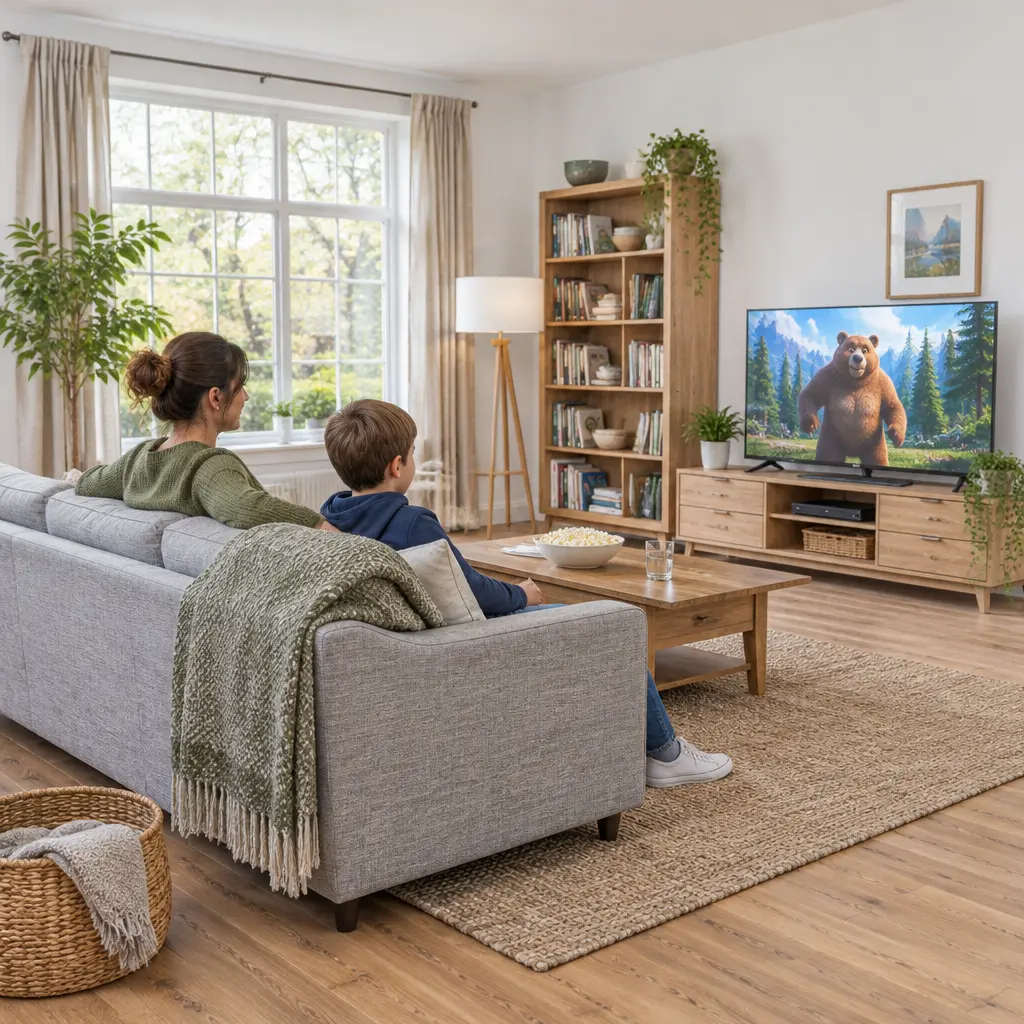
A practical example is a family watching an animated adventure in which a character is separated from a caregiver. A young child may focus on the character’s fear; an adult can acknowledge that feeling and explain how the story resolves the separation. The same scene may prompt an older viewer to discuss independence, responsibility, or the film’s use of suspense.
Age ratings, content, and individual differences
Age ratings are screening tools that summarize a classification body’s assessment of content; they are not precise measurements of an individual child’s readiness. The Motion Picture Association’s rating system, for example, provides category labels and content descriptors intended to help audiences make informed choices. Families should consider those descriptors alongside a child’s sensitivities, maturity, and prior experiences.
Two children of the same age can react differently to violence, grief, peril, or loud effects. Likewise, an adult’s response may be shaped by personal history or cultural background. A flexible approach—previewing uncertain films, watching together, and checking in afterward—is more informative than assuming age alone predicts the experience.
Film Experience and Age: Conclusion
Children and adults differ in film experience because attention, memory, emotional regulation, background knowledge, and interpretive skills develop and vary over time. Children may focus on vivid action and immediate feelings, while adults may more readily infer motives, recognize genre conventions, and interpret symbolism. Yet age is only one influence: personality, culture, experience, content, and viewing context all matter.
Families, educators, and filmmakers can use these insights to choose suitable films, support thoughtful co-viewing, and build media literacy. Rather than asking only whether a movie is “for” a certain age, consider what the viewer can understand, how the content may feel, and what conversation could help. For further reading, consult the American Academy of Pediatrics’ guidance on children and media, the World Health Organization’s physical-activity and sedentary-behaviour guidelines, and the Motion Picture Association’s rating information.
Sources: American Academy of Pediatrics, “Media and Young Minds,” Pediatrics, 2016, https://publications.aap.org/pediatrics/article/138/5/e20162591/60314/Media-and-Young-Minds; American Academy of Pediatrics, “Children and Media Tips from the American Academy of Pediatrics,” https://www.healthychildren.org/English/family-life/Media/Pages/default.aspx; World Health Organization, Guidelines on Physical Activity, Sedentary Behaviour and Sleep for Children under 5 Years of Age, 2019, https://www.who.int/publications/i/item/9789241550536; Motion Picture Association, “Film Ratings,” https://www.motionpictures.org/film-ratings/; Piaget, Jean, The Psychology of the Child, Basic Books, 1969.