
Cinema’s technological turning points are innovations that changed how films are made, distributed, or experienced. From synchronized sound and color to digital cameras, computer-generated imagery, streaming, and high-dynamic-range projection, each shift has altered both filmmaking practice and audience access. The changes are measurable: the Motion Picture Association reported that global theatrical and home/mobile entertainment revenue reached $99.7 billion in 2023, while the Academy of Motion Picture Arts and Sciences has recognized digital cinema and other technical advances through its Scientific and Technical Awards. These turning points matter because they reshape creative choices, business models, preservation needs, and who can watch films—and where.
How Cinema’s Technological Turning Points Changed Film Production
A technological turning point in cinema is an innovation—or a combination of innovations—that significantly changes film production, exhibition, distribution, or preservation. Film historians and institutions generally describe such shifts by their effects rather than by a single invention date: technologies often develop over years, coexist with older systems, and become standard at different speeds. The transition from silent to sound cinema, for example, was not simply the arrival of a microphone; it required synchronized recording, compatible projection, new studio practices, and changes in performance and editing.
The major production turning points include synchronized sound, color cinematography, widescreen formats, lightweight cameras, digital image capture, and computer-generated imagery. Their effects are visible in both craft and commerce. The transition to digital production, in particular, changed how images are captured, edited, copied, and delivered, while continuing to rely on specialized formats and long-term preservation practices.
Synchronized Sound and the End of the Silent Era
Synchronized sound is the recording and playback of dialogue, music, and effects in coordination with moving images. Warner Bros.’ The Jazz Singer (1927), which combined silent-film intertitles with synchronized musical and spoken passages, became a widely recognized milestone in the commercial adoption of sound. The Library of Congress notes that the transition involved competing sound-on-disc and sound-on-film systems, as well as substantial investment in recording equipment and theater upgrades.
Sound transformed acting, screenwriting, editing, and exhibition. Studios had to manage microphones, recording spaces, and synchronized playback; performers adapted their voices and delivery; and dialogue became an important storytelling tool. The change was gradual: silent films continued to be made after sound became commercially dominant, and early sound equipment sometimes limited camera movement. The episode illustrates a recurring pattern in cinema history: an innovation becomes influential only when production technology, distribution infrastructure, and audience demand align.
Color, Widescreen, and the Scale of the Image
Color cinematography records or reproduces color as part of the film image, while widescreen formats use a broader frame to expand the visible field. Earlier color processes existed before Technicolor became prominent, but three-strip Technicolor helped make richly controlled color a major studio feature. Films such as The Wizard of Oz (1939) and Gone with the Wind (1939) demonstrated how color could serve narrative and spectacle, not just realism.
Widescreen formats gained momentum in the 1950s, as studios sought to distinguish theatrical exhibition from television viewing. Cinerama, CinemaScope, and other systems offered larger or wider images, often accompanied by improved sound. The shift affected composition, set design, projection, and theater architecture. Color and widescreen did not replace earlier formats overnight; rather, filmmakers and exhibitors used them selectively, according to story, budget, and venue.
Digital Cameras, Editing, and Computer-Generated Imagery
Digital cinema uses electronic sensors to capture images and digital systems to edit, process, store, or project them. The change reduced dependence on physical camera negative for many productions and enabled rapid review, flexible post-production, and efficient duplication. Digital workflows also introduced new requirements, including color management, data storage, format compatibility, and migration to prevent files from becoming inaccessible.
Computer-generated imagery (CGI) creates or modifies visual elements using computers, either as fully synthetic images or in combination with photographed material. Jurassic Park (1993) helped demonstrate the potential of digital creatures integrated with live-action photography, while later advances enabled increasingly complex environments and characters. The Academy of Motion Picture Arts and Sciences’ Scientific and Technical Awards recognize technical contributions across filmmaking; their history reflects how advances in cameras, effects, and post-production often depend on many linked tools rather than one breakthrough.
Together, these production innovations changed what could appear on screen. Their impact, however, depended on the systems that carried films from studios to audiences, making exhibition and distribution the next major arena of transformation.
How Cinema’s Technological Turning Points Changed Exhibition and Distribution
Exhibition and distribution technologies determine how films reach viewers and what viewing conditions are possible. The key turning points include standardized projection, television and home video, digital cinema projection, and online streaming. Each shifted the balance among theaters, studios, distributors, and audiences, while creating new questions about access, revenue, and control.
From Film Prints to Digital Cinema Projection
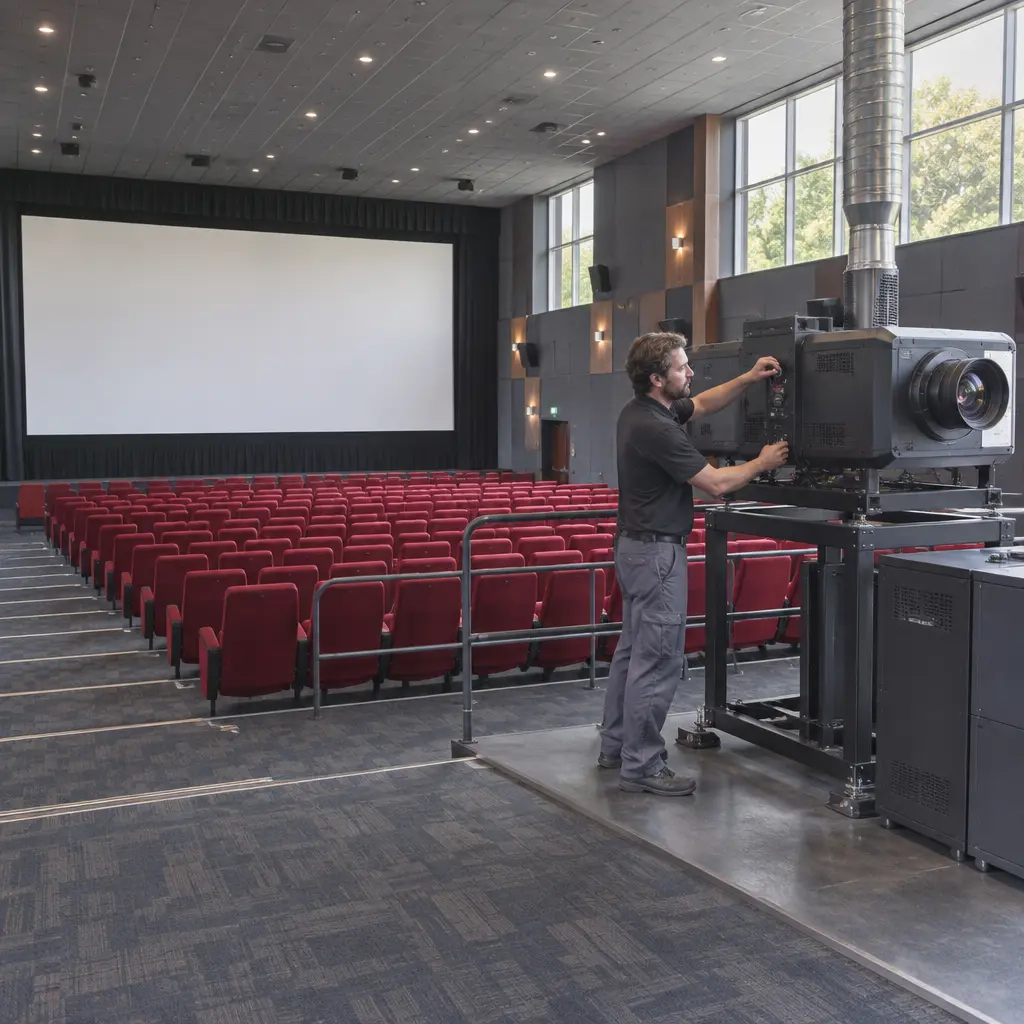
Digital cinema projection displays a digitally encoded film package rather than projecting a conventional celluloid print. The Digital Cinema Initiatives (DCI), a consortium of major studios, published technical specifications intended to support consistent digital theatrical presentation, including image, sound, security, and interoperability requirements. Digital distribution can reduce the need to manufacture and ship a separate film print for each theater, but it requires projection systems, servers, secure content delivery, and ongoing maintenance.
The change is distinct from simply showing a video file in a theater: professional digital cinema depends on agreed technical standards and calibrated equipment. The transition also illustrates a practical trade-off. Digital copies are easier to reproduce and transport than physical prints, yet theaters must invest in specialized systems, and distributors must manage secure delivery and format compatibility.
Television, Home Video, and the Expanding Audience
Television brought moving images into homes, while home-video formats such as VHS and DVD allowed viewers to choose when to watch and, in many cases, to replay or collect films. These technologies changed cinema’s economic life: a film could earn revenue beyond its theatrical run and reach viewers who did not attend a theater. They also altered everyday film culture, supporting repeat viewing, home libraries, and new forms of audience discovery.
The shift did not make theaters obsolete. Instead, it created a more complex release ecosystem in which theatrical exhibition, broadcast, physical media, and later digital services could complement or compete with one another. The Motion Picture Association’s 2023 report, Theme Report, estimated global theatrical and home/mobile entertainment revenue at $99.7 billion, reflecting the scale of a market that now spans multiple screens and delivery models.
Streaming and On-Demand Distribution
Streaming delivers audiovisual content over the internet for playback as data arrives, rather than requiring viewers to obtain a complete physical copy first. Subscription video-on-demand, ad-supported services, and transactional rentals have expanded choices in how films are released and watched. The technology supports broad catalogs and convenient access, while raising questions about licensing, regional availability, discoverability, and whether a title remains accessible over time.
Streaming also changes release strategies. A film may premiere in theaters, online, or through a staggered window, depending on the distributor’s plans and market conditions. The COVID-19 pandemic accelerated experimentation with these approaches, but theatrical and online viewing have continued to coexist. The MPA’s revenue figures provide a useful indicator of the combined market, though they should not be mistaken for a count of streaming subscribers or a direct comparison of individual platforms.
As delivery moves from physical prints and discs to files and streams, preservation becomes a central concern. Easier access does not guarantee that films, production materials, or the technology needed to play them will remain available.
How Cinema’s Technological Turning Points Affect Preservation and Access
Film preservation is the work of safeguarding moving images and the materials needed to understand, reproduce, and access them. It includes physical conservation, restoration, documentation, and, increasingly, digital preservation. The turning points that make filmmaking and distribution more efficient can also create new vulnerabilities: celluloid can decay, obsolete formats can become difficult to play, and digital files can be lost through hardware failure or neglected migration.
Film Stock, Restoration, and the Survival of Earlier Cinema
Nitrate film, used widely in early cinema, is chemically unstable and can become a fire hazard as it deteriorates. The National Film Preservation Foundation explains that many silent-era films have been lost, in part because of the instability of early film stock, deliberate disposal, and inadequate storage. Preservation work can involve copying surviving material to safer film stock, repairing damaged elements, and documenting the provenance of each version.
Restoration is not merely cleaning an image. It can require comparing multiple surviving prints, reconstructing missing footage, correcting color or sound, and making interpretive decisions about what viewers should see. Institutions such as the Library of Congress and the National Film Preservation Foundation show why preservation depends on both technical expertise and careful historical research.
Digital Preservation and Long-Term Access
Digital preservation is the planned management of digital files so they remain authentic, usable, and understandable over time. It may require multiple copies, geographically separate storage, integrity checks, detailed metadata, and periodic transfer to current storage systems and file formats. A digital master is not automatically permanent: storage devices fail, formats become unsupported, and the context needed to interpret a file can be lost.
The Library of Congress’s digital-preservation guidance emphasizes that preservation is an ongoing process rather than a one-time act of saving a file. For contemporary cinema, that process can encompass camera originals, visual-effects assets, editing timelines, sound mixes, subtitles, and final exhibition versions. Preserving only the finished film may leave future archivists without the materials needed to verify, restore, or re-create it.
Access, Standards, and Inclusion
Access means more than making a film available: audiences may also need captions, audio description, translated subtitles, compatible devices, or reliable internet service. New distribution technologies can widen access for remote viewers and people who face barriers to theater attendance, but they can also deepen inequalities where broadband, devices, or subscriptions are unaffordable or unavailable.
Standards help connect these concerns. The DCI specifications support consistent theatrical presentation, while accessibility practices and archival metadata help make films usable across audiences and institutions. A complete assessment of a technological turning point should therefore consider not only image quality or cost, but also who benefits, what is preserved, and whether future viewers can still encounter the work.
Conclusion: Why Cinema’s Technological Turning Points Matter
Cinema’s technological turning points have repeatedly reshaped production, exhibition, distribution, and preservation. Synchronized sound changed performance and storytelling; color and widescreen expanded visual expression; digital cameras and CGI transformed image-making; and digital projection, home video, and streaming diversified how films reach audiences. At the same time, the survival of nitrate-era films and the challenges of maintaining digital files show that innovation creates preservation responsibilities as well as new possibilities.
The wider implication is that cinema’s future depends on more than the next camera, display, or platform. It also depends on sustainable business models, interoperable standards, accessible viewing, and long-term stewardship. Readers can explore the Motion Picture Association’s annual Theme Report, the Library of Congress’s film-preservation resources, and the Academy’s Scientific and Technical Awards to trace how technical advances continue to shape the medium.
Sources: Motion Picture Association, 2023 Theme Report, https://www.motionpictures.org/research-docs/2023-theme-report/; Academy of Motion Picture Arts and Sciences, Scientific and Technical Awards, https://www.oscars.org/sci-tech; Library of Congress, National Film Preservation Board, https://www.loc.gov/programs/national-film-preservation-board/; National Film Preservation Foundation, Film Preservation Guide, https://www.filmpreservation.org/preservation-basics/the-film-preservation-guide; Digital Cinema Initiatives, Digital Cinema System Specification, https://www.dcimovies.com/specification/; Library of Congress, Sustainability of Digital Formats: Planning for Library of Congress Collections, https://www.loc.gov/preservation/digital/formats/.