
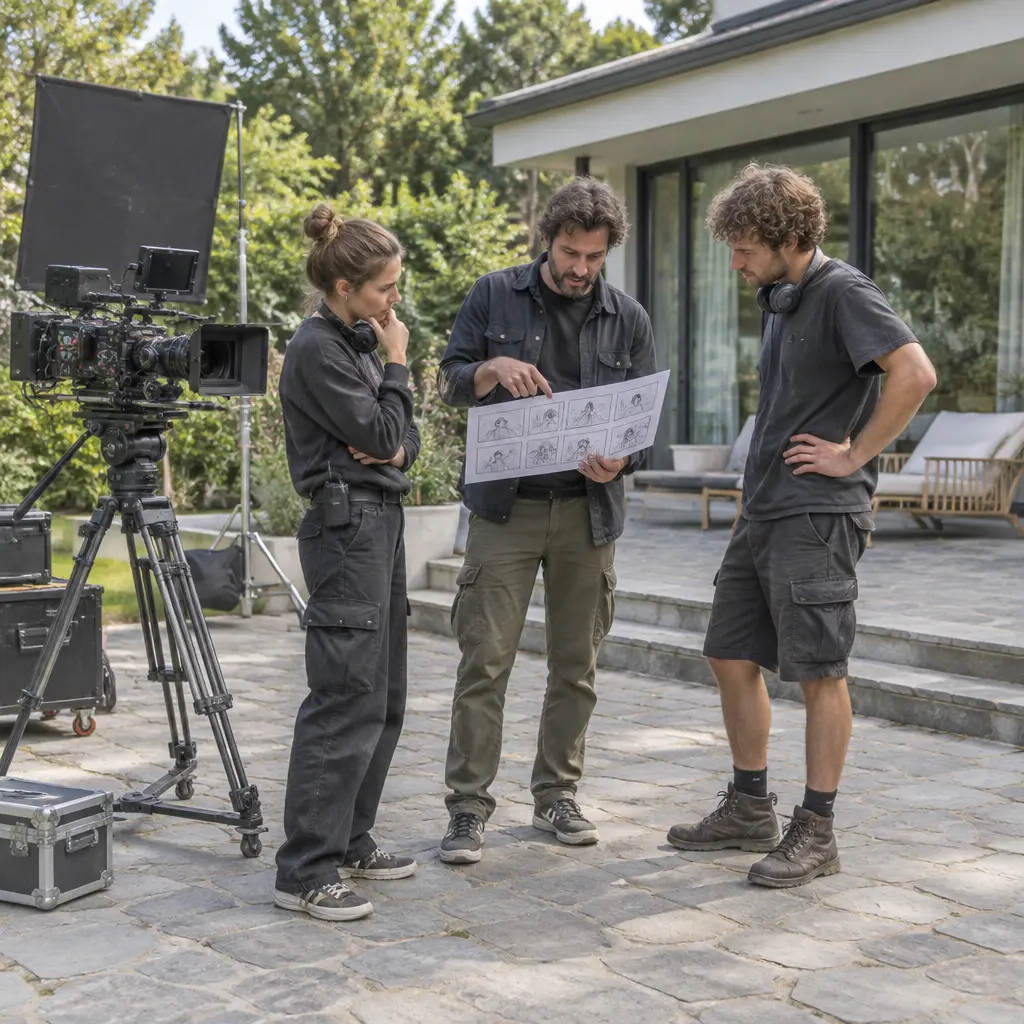
A long-running filmmaking crew is a group of trusted collaborators who return across multiple projects, often working with the same director for years or decades. Filmmakers such as Martin Scorsese and editor Thelma Schoonmaker, and Akira Kurosawa and composer Fumio Hayasaka, show why these partnerships can endure: repeated work builds shared creative shorthand, reliable craft, and mutual trust. That continuity is not a guarantee of success, but it can help a production make complex decisions faster, preserve a distinctive style, and take creative risks—while also bringing challenges such as routine, limited perspectives, and fewer opportunities for new collaborators.
Long-Running Film Crews Build Creative Continuity
A filmmaker’s recurring crew is not necessarily a fixed unit: a director may retain an editor or cinematographer while changing other department heads to suit a particular story. The underlying advantage is accumulated knowledge. Crew members learn how a filmmaker communicates, what kinds of images or performances they seek, and how they respond when a scene is not working. The result can be less time spent translating intentions and more time spent shaping the film.
The U.S. Bureau of Labor Statistics describes film and video production as work requiring collaboration among directors, producers, camera operators, editors, and other specialists. Its Occupational Outlook Handbook projected 8% employment growth for producers and directors from 2023 to 2033, faster than the average for all occupations. That projection does not measure the value of repeat crews, but it underscores the continued demand for people who can coordinate complex creative work. No widely accepted industry statistic counts how many directors keep the same crew for decades; the strongest evidence is therefore found in documented collaborations and in research on teamwork, trust, and creative production.
Repeated Collaboration Turns a Crew into a Creative System
A recurring film crew is a network of creative and technical professionals who repeatedly collaborate with a filmmaker. It is more than a list of familiar names: over time, members develop shared expectations about decision-making, communication, and quality. Researchers Bruce W. Tuckman and Mary Ann C. Jensen’s review of group-development research describes how groups can move through forming, conflict, norm-setting, and effective performance, while noting that real groups do not always follow a simple, linear sequence. In filmmaking, repeated projects can help a team reach effective collaboration more quickly because some working norms are already established.
This continuity can take several forms: a director-editor partnership, a director-cinematographer relationship, a composer’s recurring work with a filmmaker, or a broader production company and department network. Each preserves a different kind of knowledge. Editors carry understanding of rhythm and performance; cinematographers know how a director responds to light and camera movement; production designers retain visual references; composers become familiar with a film-maker’s musical instincts.
Shared Creative Language Reduces Translation
A shared creative language is the set of references, habits, and shorthand collaborators develop through experience. A director may be able to describe a scene using a brief comparison or an incomplete thought because a longtime collaborator already understands the desired mood. That does not eliminate discussion; it can make discussion more precise, allowing the team to move from a general intention to specific choices about framing, sound, editing, or performance.
The efficiency matters because film sets operate under constraints: schedules, budgets, locations, and the availability of performers all limit experimentation. Familiarity can help the crew identify which ideas need extended testing and which can be executed with confidence. It is an advantage in communication, not evidence that repeat teams automatically work faster on every production.
Trust Makes Creative Risk Easier
Trust is confidence that collaborators will act competently, communicate problems, and support a shared goal. When a director trusts a cinematographer or editor, the director may be more willing to try an unusual visual approach, preserve an unconventional performance, or revise an established plan. The collaborator, in turn, may feel able to challenge an idea without making disagreement personal.
Trust is particularly valuable when a production faces uncertainty, such as a difficult location or a scene that changes during filming. It should not be confused with automatic agreement: productive trust allows candid feedback. A crew that avoids disagreement simply because its members have worked together for years may protect comfort at the expense of the film.
Repeated Work Preserves Institutional Memory
Institutional memory is practical knowledge that remains with people rather than being fully captured in manuals: how a filmmaker prefers to review dailies, which visual references resonate, what production approaches have failed, and how departments coordinate under pressure. A returning crew can carry that knowledge from one project to the next, reducing the need to rediscover every working preference.
The benefit is not simply speed. Continuity can preserve a coherent approach across a filmmaker’s body of work, while still allowing each film to differ in genre, scale, or subject. This is especially useful for collaborators whose work affects a film’s overall texture, such as editors, cinematographers, production designers, and composers.
Long-Term Film Partnerships Shape Style and Craft
A recurring crew becomes most visible when a director’s style depends on close collaboration across several stages of production. The director may originate an idea, but its final form emerges through decisions about performance, images, sound, and rhythm. Long-term partnerships help connect those decisions. They can also create a recognizable artistic signature, even when individual films vary considerably.
Director and Editor: Finding the Film in the Footage
The director-editor partnership is central because editing determines how performances, images, and sound become a finished sequence. Thelma Schoonmaker has edited Martin Scorsese’s films for decades, beginning with Raging Bull (1980). Their continued collaboration spans works with different subjects and forms, from Goodfellas to The Irishman. The example illustrates how a long-standing editor can understand a director’s instincts about tempo, transitions, and performance while still making choices specific to each project.
An editor is not merely a technician who follows instructions. The editor can identify a scene’s strongest material, question a director’s assumptions, and help reveal a film’s emotional structure. Familiarity can make that exchange more direct, but the relationship still depends on judgment and the ability to revise.
Director and Cinematographer: Building a Visual Grammar
A visual grammar is the recurring set of choices through which a film communicates: camera distance, movement, lighting, color, and composition. Roger Deakins and the Coen brothers worked together on films including Fargo, No Country for Old Men, and True Grit. Their repeated collaboration demonstrates how a cinematographer can help realize a director’s visual ideas while adapting those ideas to different stories and settings.
A cinematographer’s long-term familiarity with a director can make visual planning more nuanced. The team can discuss not just how a shot should look, but why a particular perspective suits a character or moment. At the same time, the camera department must remain responsive to the production’s specific needs rather than applying a familiar look by default.
Director and Composer: Making Sound Part of the Story
A recurring composer can learn the filmmaker’s preferences about musical texture, silence, instrumentation, and the relationship between score and image. Japanese director Akira Kurosawa collaborated with composer Fumio Hayasaka on several films, including Drunken Angel, Rashomon, and Seven Samurai. Their work shows how music can contribute to a film’s atmosphere and dramatic shape, rather than simply decorate the finished scenes.
Long-term familiarity can also help a composer understand when a director wants music to lead, when it should recede, and when silence carries greater force. These are artistic judgments rather than guaranteed outcomes, and a new composer can bring valuable ideas that a familiar partnership might not produce.
Production Companies: Continuity Beyond One Department
Sometimes the durable partnership is organizational rather than limited to a single craft. A production company can retain creative and administrative knowledge across projects, helping a filmmaker develop scripts, assemble collaborators, and maintain a working environment. Pixar’s relationship with directors and production teams across multiple animated features offers a prominent example of a studio structure in which story development and production expertise are built over repeated projects.
Organizational continuity can support long development processes, but it also raises questions about whose ideas are heard and how a studio balances familiar methods with fresh perspectives. The most effective systems preserve learning without treating past success as a formula.
The Benefits Come with Trade-Offs
A long-term crew can make collaboration more coherent, but longevity alone does not create good work. A familiar group may communicate efficiently and still fall into predictable choices. The question for filmmakers is not whether to keep or replace a crew wholesale; it is how to preserve useful trust and knowledge while continuing to invite challenge and new viewpoints.
Efficiency Must Not Become Complacency
A team that knows its routines may spend less time establishing basic working relationships. Yet the same routines can become assumptions: a familiar camera setup, editing rhythm, or production method may be repeated without asking whether it suits the new material. Directors can counter this risk by setting project-specific goals and asking collaborators to explain the reasoning behind familiar choices.
Loyalty Must Leave Room for New Voices
Long-running partnerships can concentrate opportunities among a small circle. That may limit access for emerging professionals or exclude perspectives that could enrich the work. Hiring new collaborators in selected roles, bringing in consultants, or rotating department members can introduce fresh approaches while keeping the benefits of established relationships.
This balance matters beyond artistic variety. Film production is a large, specialized labor market, and the Bureau of Labor Statistics tracks a broad range of occupations involved in creating and distributing film and video. A healthy industry needs both durable working relationships and pathways for new professionals to gain meaningful responsibility.
Familiarity Needs Clear Feedback and Boundaries
Close relationships can make feedback easier, but they can also make it harder if collaborators fear that disagreement will damage a personal bond. Clear creative goals, respectful debate, and defined responsibilities help prevent familiarity from blurring professional boundaries. A director should make room for dissent, and department leaders should be able to explain practical concerns without being treated as disloyal.
How Filmmakers Can Build Durable Collaborations
Long-term creative partnerships are built through repeated work, but they also require deliberate care. Directors and producers can treat each production as a chance to renew the collaboration rather than assume that previous success guarantees future agreement.
- Choose collaborators for both craft and communication: technical ability matters, but so does the capacity to discuss problems candidly.
- Share the project’s aims early: a clear brief gives departments a common point of reference while leaving room for creative interpretation.
- Review what worked and what did not: short post-production discussions help convert experience into useful knowledge rather than unexamined habit.
- Invite constructive disagreement: ask trusted collaborators to identify risks, alternatives, or assumptions that may not fit the new film.
- Make space for new perspectives: bring in emerging professionals or new department members where their skills can challenge and expand the established team.
A useful visual for this topic would be a collaboration timeline tracing a director’s recurring editor, cinematographer, composer, and production designer across films. Such a chart could show where continuity is concentrated—and where a filmmaker deliberately brings in new partners—without suggesting that every crew member stays for every project.
Conclusion: Continuity Works Best When It Stays Open
Filmmakers often return to the same crew because repeated collaboration builds shared language, trust, practical memory, and a connected approach to craft. Partnerships such as Scorsese and Schoonmaker, the Coen brothers and Deakins, and Kurosawa and Hayasaka show how that continuity can shape editing, imagery, and sound across distinct films. But a stable crew is not automatically a better crew: it must remain open to disagreement, new talent, and the demands of each story.
For filmmakers, the practical goal is not loyalty for its own sake, but a working culture in which people know one another well enough to take creative risks and remain candid enough to challenge familiar solutions. Readers interested in the subject can explore film credits and production histories alongside interviews with directors and crew members to see how these relationships evolve from one project to the next.
Sources: U.S. Bureau of Labor Statistics, “Producers and Directors,” Occupational Outlook Handbook, https://www.bls.gov/ooh/entertainment-and-sports/producers-and-directors.htm; Bruce W. Tuckman and Mary Ann C. Jensen, “Stages of Small-Group Development Revisited,” Group & Organization Studies, 1977, https://doi.org/10.1177/105960117700200404; The Academy of Motion Picture Arts and Sciences, “Thelma Schoonmaker,” https://www.oscars.org/oscars/ceremonies/2012; Encyclopaedia Britannica, “Roger Deakins,” https://www.britannica.com/biography/Roger-Deakins; The Criterion Collection, “Akira Kurosawa: The Films,” https://www.criterion.com/films/; Pixar Animation Studios, “Our Story,” https://www.pixar.com/our-story.